Regional District of Nanaimo Area B budget 2026
Come and join me for an RDN budget presentation and 2026 project updates at the library on June 17th 2:15-4 pm, or on June 20th 2-3:45 pm!
We all received our tax notices recently which includes taxes owing to the province, other authorities (e.g., Municipal Finance Authority), the Regional District of Nanaimo (RDN), Islands Trust, and Gabriola Fire Improvement District. The RDN pamphlet that accompanied the tax notice included information about the RDN-wide budget and services on one side and Area B-specific information on the other. There has been some confusion because the RDN-wide side indicated that taxes were going to wastewater treatment as well as some other categories; however, in Area B we do not receive those services so we do not pay taxes towards them. You can see the Area B-specific list of categories is much smaller.
Below I provide information about the 2026 RDN budget for Area B (Gabriola, Mudge, and DeCourcy Islands). As indicated on your tax notice, to avoid late payment penalties, claim your 2026 home owner grant by July 2 2026. Apply online at gov.bc.ca/homeownergrant or by phone at 1-888-355-2700.
On your tax notice the following items represent RDN taxes: Area B Nanaimo (all Area B pays this rate), Gabriola Isl Noise (just Gabriola pays), Gabriola Isl Rec (just Gabriola pays), Gabriola Health and Wellbeing (just Gabriola pays), and the parcel tax for WTR/WTRSHD Protec (for the Drinking Water and Watershed Protection program; all areas in the RDN pay).
Area B assessment information
The “average” property in Area B was assessed by BC Assessment at $684,200 for 2026, a 3.6 % increase from the average in 2025 ($660,400). Average property assessments varied across the Regional District with Area B having the lowest average assessment; Area E (Nanoose) had the highest average property assessment in the region at $1,289,431. Area B properties had the third highest average rate of property assessment increase in the region after Areas C and Area A (3.8% increase) which has implications for services which are apportioned across the region by assessment.
Area B budget total and property taxes
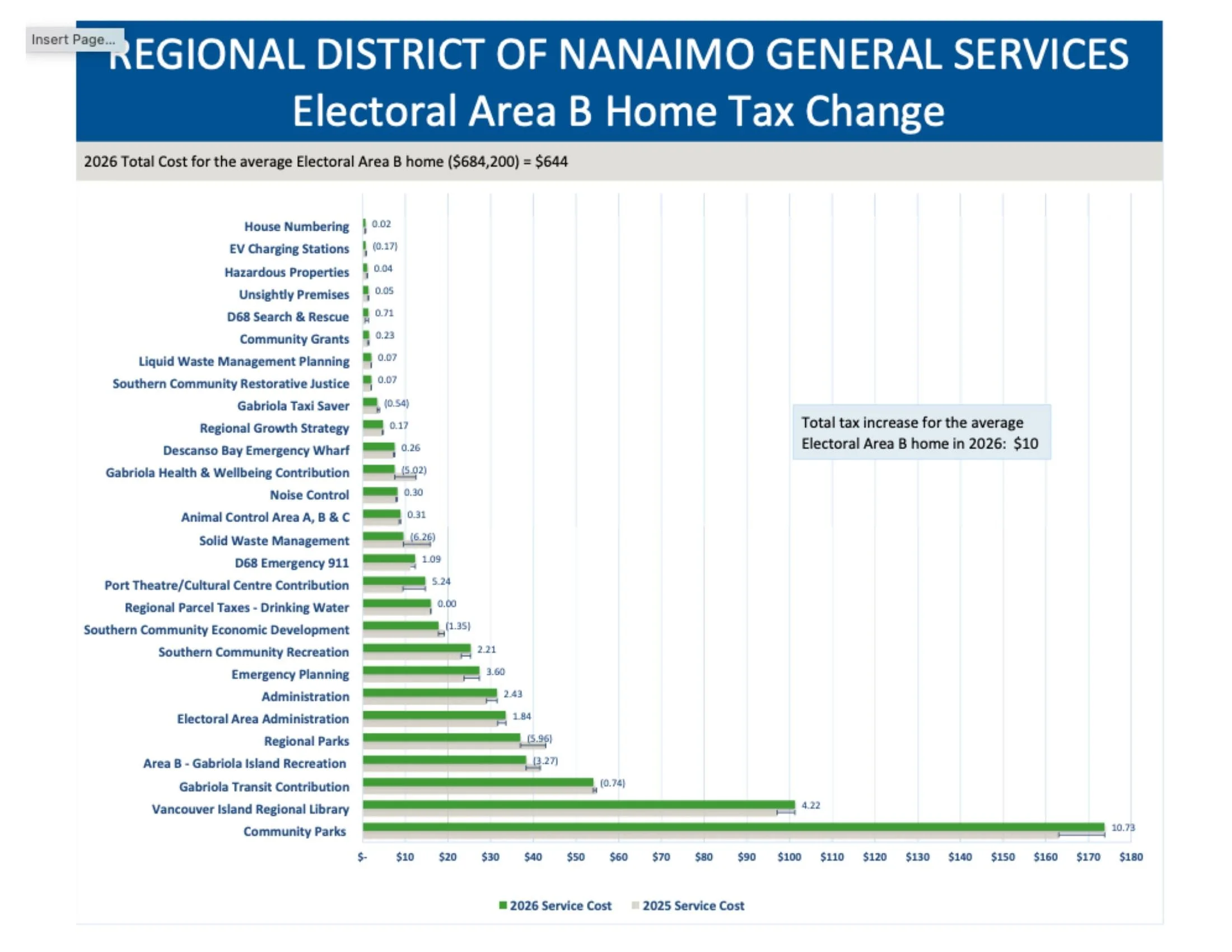
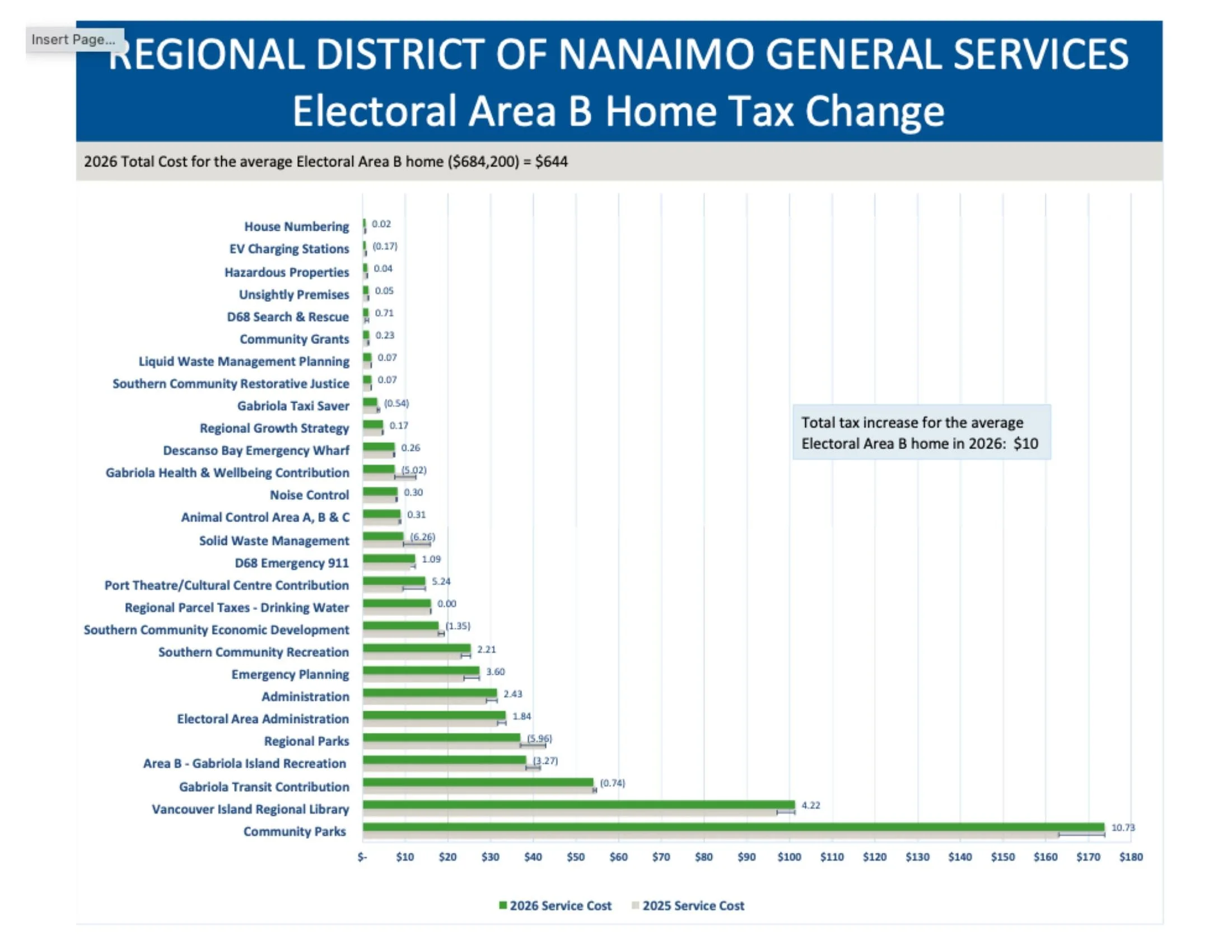
The total 2026 RDN budget for Area B is $2,553,050 for 2026, which is a 1.7% increase over 2025 (which totaled $2,509,885). For the “average” property on Gabriola valued at $684,200 that equates to taxes of $643.62, which is an increase of $10 in 2026 taxes vs 2025 for the “average” home in each year.
To calculate your RDN property taxes for your Gabriola property: divide your property assessment by 100,000, multiply by $91.73 (which is the tax per $100,000 of your assessment) and add $16 for the parcel tax. For example, for a Gabriola property assessed at $750,000: ((750,000/100,000) x 91.73) + 16 = $703.98. Property taxes are collected by the province on behalf of Regional Districts; your assessment will include an additional 5.25% fee to the province. The same is true for Islands Trust and Gabriola Fire Improvement District taxation.
Properties on Mudge and DeCourcy do not contribute to some services such as the taxi saver program, noise control, Gabriola Island Recreation, or the Health and Wellbeing Coordinator service. To calculate the property taxes for your Mudge or DeCourcy property: divide your property assessment by 100,000, multiply by 83.34 (which is the tax assessment per $100,00 of your assessment), and add $16 for the parcel tax. For example, a Mudge property assessed at $750,000: $641.05. The province charges an additional 5.25% fee for collection of taxes for the Regional District and Islands Trust.
Regional District budgeting
The Regional District of Nanaimo (RDN) is service-oriented and collects taxes for services delivered. The RDN provides 115 different services across the region and each service is taxed for and tracked separately. Only a few services are truly regional where all electoral areas and municipalities participate, including regional parks, solid waste (the landfill), grants in aid, regional growth management (Area B participates to a lesser extent than other areas because Islands Trust does landuse planning here), drinking water and watershed protection, liquid waste management planning, and administration. The rest of the services have a variety of combinations of area participation. The financial plan has a great table starting on page 7 that lists all of the services the RDN provides and indicates which areas participate in the service.
We pay only for those services that we receive: Gabriola participates in 28 of the 115 services, and Mudge and DeCourcy participate in 24. Funds that are taxed for a service can only be used for that service and no other. For example, if taxes are collected for Area B community parks, the funds can’t be used for something else (eg regional parks or GERTIE or Descanso Bay emergency dock, or community parks in a different area).
To provide some additional examples, we do not pay taxes towards maintenance or upkeep of the RDN’s Ravensong Aquatic Centre in Parksville, but we do pay taxes toward the operations of the Nanaimo Aquatic Centre, Beban Aquatic Centre, and the Nanaimo arenas through the Southern Community Recreation line item. Similarly, we don’t pay taxes towards the RDN transit system, and other areas don’t contribute to our Gabriola transit system, GERTIE. Another example is the difference between regional and community parks. Costs for regional parks (such as Descanso Bay and Coats Marsh Regional Parks) are shared amongst all the RDN electoral areas and municipalities whereas community parks are paid for and maintained solely by the community(ies) where they are located – all of the acquisition, maintenance, and any capital costs for Community Parks on Gabriola, Mudge, and DeCourcy are paid for solely through Area B taxation. We do not pay towards sewage or water treatment because we don’t have those services, although Area B pays a total of $8,072 in 2026 which goes toward the SepticSmart program and towards liquid waste treatment because they receive our septage.
The calculation for regional services can be complicated. Many of the service costs are attributed across the region on an assessment basis or a combination of population/assessment. That means the increase or decrease in taxes for a service isn’t necessarily directly related to the overall budget item. For example, in a service where the overall budget increased 5% and the cost is apportioned by assessment, the increase for a particular property may not be 5% - for properties where the assessment increased at a higher rate than another, the relative increase will also be larger.
Where do our taxes go?
We pay for a variety of services through the RDN:
· Services paid for by Gabriolans only (and not Mudge or DeCourcy or other areas in the RDN): funding for recreation programming to the Gabriola Recreation Society, the Gabriola Arts Council, the Gabriola Taxi Saver program, the Gabriola Health and Wellbeing Service (new in 2024), and noise control bylaw enforcement on Gabriola.
· Services paid for by Area B only (and no other areas in the RDN): funding to GERTIE, the Gabriola Museum, the Gabriola Emergency Wharf, Gabriola Green Wharf, economic development (Gabriola Island Chamber of Commerce), Area B community parks and halls, provide a grant to GaLTT, and have feasibility funds if necessary to explore a new service.
· Services paid for by Area B and at least 1 other area in the RDN: bylaw (building inspection, hazardous properties, unsightly premises, animal control, house numbering), liquid waste management planning (we don’t pay for water systems or sewer but we do contribute to the Septic Smart program and planning for septage receiving), southern community restorative justice (victim services), Port Theatre contribution, electric vehicle charging station, emergency services (emergency planning, D68 search and rescue, D68 911), Vancouver Island Regional Library (the VIRL Board sets the budget and it’s attributed to the electoral areas according to the Library Act; municipalities are taxed directly), and electoral area administration.
· Services paid for by all of the areas across the RDN (ie all 7 electoral areas and 4 municipalities): regional parks and trails, drinking water and watershed protection program (which includes water monitoring, rebates, and public education), solid waste services (including landfill and implementing the solid waste management plan – note that waste pickup is a user-pay system and is not funded through taxation), a grants-in-aid program to non-profits, regional growth management (which includes projects such as sea level rise mapping and climate change action although we are not included within the overall Regional Growth Strategy for the region), and administration.
Information in the table
The accompanying table shows the actuals for Area B from 2022 to 2026, with notes on some 2026 budget items. The table also shows who pays for each service and how the costs are apportioned.
Do you have any questions? Please join me at one of my budget presentations on June 17th or June 20th, or feel free to reach out to me at vanessa.craig@rdn.bc.ca or 250.741.4589.
Best,
Vanessa Craig